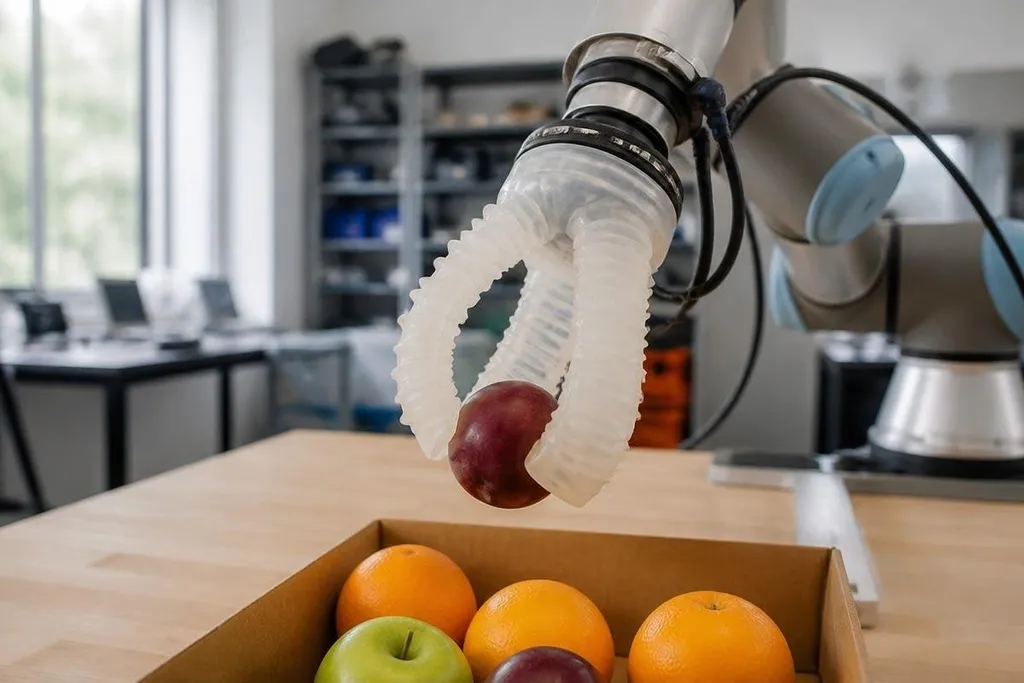
A soft robot can bend, squeeze, and change shape where a rigid arm would need another joint. That shift is changing how engineers build grippers, medical tools, and robots that work near people.
The idea is practical: replace some metal links and motors with flexible materials, air pressure, cables, or shape-changing polymers. The trade is clear too. Soft robots can handle delicate objects, but they are harder to control with exact force and position.
Quick read
- Flexible bodies can spread contact force across fragile objects.
- Pneumatic actuators use air pressure to bend silicone chambers.
- Better sensing and control are still needed for repeatable factory work.
Why soft materials change the design
A rigid robot moves through set joints. Each joint has a motor, gears, bearings, and limits. With a flexible body, one section may do the work of several rigid joints.
That matters when the robot must reach around an object or fit into a narrow space. A flexible arm can curve through a pipe, while a rigid arm may need extra joints and a larger control system.
Soft parts also spread force over a wider area. A hard gripper may crush a tomato if its force control is poor. A silicone finger can wrap around the tomato and share the load across its surface.
The robot still needs sensors, but the material helps before software makes a correction.
How soft robots move
One common design uses a silicone body with hollow air chambers. Pumping air into one side makes that side expand, so the body bends toward the side with less expansion. Reversing the pressure changes the bend.
These parts are called pneumatic artificial muscles or fluidic actuators. They can be light and easy to make, but they need a pump, valves, tubing, and a way to measure pressure. Those parts can make a small robot less portable than its flexible body suggests.
Other designs pull tendons through a flexible structure. A motor shortens the cable, and the body curves. This approach can give faster movement than air pressure, though cable stretch and wear affect the robot's position.
Shape-memory materials take a different route. A wire or polymer changes shape after heating. That can remove a motor from a small mechanism, but heating and cooling take time, which limits repeated motion.
Where the approach helps
Soft grippers are a clear use case. A gripper with flexible fingers can pick food, fabric, or mixed objects without needing a separate hard tool for every shape. This can reduce tool changes on a packing line, though the gripper still needs a known range of object weights and surfaces.
Medical robots also benefit from flexible bodies. A soft catheter or continuum robot can curve through the body with less room than a straight rigid tool. Its shape can follow a path instead of turning at a few fixed joints.
Researchers also use soft parts in wearable robots and search machines. A wearable actuator can move with a person's joint, while a small inspection robot can squeeze through gaps that block rigid hardware.
Soft parts can bend around a person or object, but that flexibility can make force harder to control. For the next step, Robot24 reports on the companies, machines, and research behind soft robotics.
The limits engineers still face
A soft body has many possible shapes. That makes its motion harder to calculate than the motion of a rigid link. Small changes in air pressure, load, temperature, or material wear can change the result.
Sensors help, but placing them inside rubber or fabric is difficult. A camera can measure the outside shape, while stretch sensors can report local strain. Neither method gives a perfect view of the force at every contact point.
Manufacturing is another concern. A metal joint can be measured and replaced as one part. A molded silicone actuator may need careful inspection for leaks, cracks, and changes in stiffness. That affects repair time and the cost of keeping a machine running.
Soft robots also work best when their task matches their strengths. A flexible gripper may handle varied objects well, while a rigid gripper may place one part at the same millimeter-level position thousands of times.
A buying and design checklist
Before choosing soft robotics for a project, check these points:
- Object range: list the lightest, heaviest, hardest, and most fragile items.
- Force data: decide how the robot will measure contact force or pressure.
- Air supply: allow space for pumps, valves, tubing, and filters.
- Repeatability: test the same motion after heat, wear, and load changes.
- Repair plan: price spare actuators and set a leak-check routine.
- Task fit: use flexible motion where shape varies; use rigid motion for fixed placement.
Soft robotics won't replace rigid robots across a factory. It gives designers another way to handle contact, shape, and limited space. I'd choose it when the object changes from run to run and gentle contact matters more than millimeter-level placement.
The next design question is how much sensing can fit inside a soft body without taking away the flexibility that made the robot useful.